Your Marketing Makes Perfect Sense. So Why Isn’t Anyone Taking Action?
 Kevin Arrow
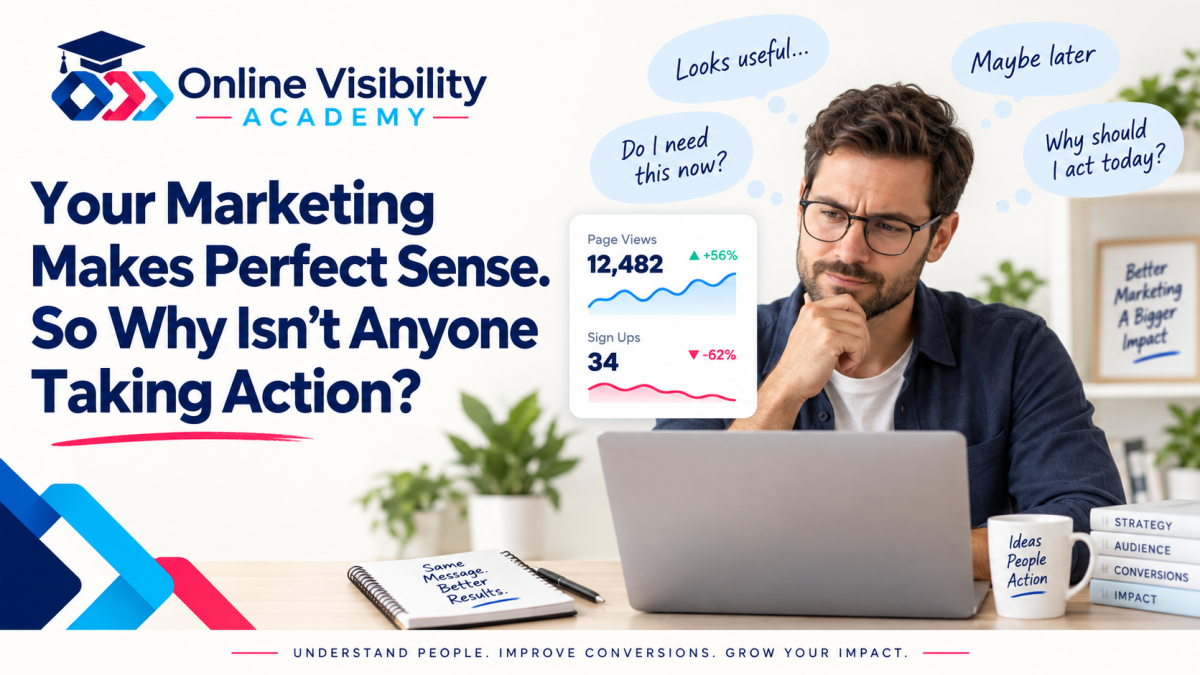
Discover why clear marketing can still fail to get action and what may be stopping customers from taking the next step.
You’ve explained what you sell. Your website looks decent. Your prices are clear. You’ve listed the benefits, added a call to action and made sure people can find everything they need.
From your point of view, the marketing makes perfect sense.
So why are people still reading, browsing and leaving without doing anything?
This is one of the most common frustrations in marketing. A business can communicate clearly and still struggle to get people to take the next step. The problem is often less about whether people understand the offer and more about whether they feel enough reason to act.
Understanding something and wanting to do something about it are two different things.
That gap between interest and action is where marketing psychology becomes particularly useful.
Understanding Your Offer Is Only the First Step
Clarity matters. If someone can’t understand what you sell, who it’s for or what they’ll get, they’re unlikely to buy.
Once those basics are covered, though, another question appears: why should they act now?
Someone might completely understand your offer and still decide to leave it for another day. They may think it sounds useful but feel no urgency to do anything about it. They may even intend to come back later and never return.
This happens because people rarely make decisions based on information alone.
They’re also influenced by how relevant the problem feels, how confident they are about the solution, how much effort the decision seems to involve and whether there’s enough motivation to move forward.
If your marketing only explains what you offer, it may leave the customer with all the facts and very little reason to act on them.
Your Customer May Not Feel the Problem Strongly Enough
People tend to take action when a problem feels relevant to them right now.
That doesn’t mean you need to make the problem sound frightening or create unnecessary pressure. It means helping someone recognise what the problem is costing them.
Imagine you offer training on improving website conversions.
You could explain that better conversion rates can improve business performance. That’s true, but it feels fairly distant.
Now imagine helping someone recognise what poor conversion actually looks like in their business. They’re spending time creating content, paying for adverts or working hard to get people onto their website, yet hardly anyone enquires or buys.
Suddenly the problem feels more concrete.
People are more likely to act when they can clearly see how an issue is affecting them.
This is why good marketing often brings the problem into focus before talking about the solution. It helps someone recognise what’s happening in their own situation.
People Need to See Themselves in the Message
One reason marketing can feel clear but still fail to get a response is that it’s too general.
A statement such as “Improve your marketing and grow your business” is easy to understand. It could also apply to thousands of businesses and hundreds of different products.
There’s nothing for the reader to connect with personally.
More specific language creates recognition.
“Posting regularly but still struggling to turn followers into customers?” gives someone a situation they can identify with.
When people recognise their own experience in your marketing, the message becomes harder to ignore. It stops feeling like general advice and starts feeling relevant to them.
This is one of the simplest ideas in marketing psychology, yet it’s often overlooked because businesses know their products so well that they naturally describe the product first.
Your customer is usually starting somewhere else. They’re thinking about their problem.
Being Interested Doesn’t Mean Someone Is Ready to Buy
It’s easy to assume that someone who visits a sales page is close to buying. Sometimes they are. Sometimes they’re simply curious.
They might be researching options, comparing prices or trying to understand what solutions exist. They may be at the very beginning of their decision.
This matters because different people need different amounts of information before they feel ready to act.
Someone who has followed you for a year may already trust you. They might only need a clear offer and an easy way to buy.
Someone who discovered you today may need more reassurance. They might want to know who you are, whether your approach suits them and whether other people have had a good experience.
If your marketing assumes everyone is ready to buy immediately, you can miss the people who need a little more confidence first.
Useful content, testimonials, examples, clear explanations and consistent communication can all help people move towards a decision over time.
Your Call to Action May Be Asking for Too Much
Sometimes the problem isn’t the offer. It’s the next step.
A call to action that feels too big can create hesitation.
Imagine someone has just discovered a consultant through a blog post. They’re interested, but they know very little about the person yet. Asking them to book an expensive consultation immediately may feel like a big commitment.
A smaller next step may feel easier.
That could be reading another article, joining an email list, downloading a guide or looking through examples of previous work.
The right next step depends on what you sell, but the principle is simple. People are more likely to act when the action feels manageable.
For low-cost products, the distance between interest and purchase can be much shorter. Even then, the customer still needs to understand exactly what they’re buying and feel comfortable with the decision.
Too Much Thinking Can Stop People Taking Action
Businesses sometimes make buying harder by trying to be helpful.
They add more packages, more options, more bonuses and more information. They explain every possible feature and give customers several different ways to proceed.
Each addition seems useful on its own, but together they can create more work for the customer.
Now they have to compare packages, decide which bonus matters, work out which option suits them and remember what the original offer was.
When a decision starts to feel complicated, putting it off becomes easier.
People often prefer choices that feel simple to understand.
This doesn’t mean every business needs one product and one button. It means every step should have a clear purpose.
If you have three packages, make the differences obvious. If there’s one main action you want someone to take, make that action easy to find. If certain information isn’t helping the decision, ask whether it needs to be there.
Reducing unnecessary effort can make a big difference.
People Often Need Reassurance Before They Need More Persuasion
When people aren’t buying, the instinct is often to make the marketing stronger.
You might add bigger promises, more urgent language or another offer.
Sometimes what the customer really needs is reassurance.
They may be wondering whether the product is suitable for beginners. They may worry they won’t have enough time. They may be unsure how quickly they’ll get access or what happens after they pay.
These questions can seem small, but uncertainty creates friction.
Clear information reduces that friction.
If your course is suitable for people with no previous experience, say so. If they can work through it at their own pace, tell them. If access is immediate, make that clear.
Answering the right question can often do more than adding another persuasive sentence.
Trust Can Be the Missing Piece
A customer may understand your offer, want the result and still hesitate because they aren’t sure whether they trust the business selling it.
Trust develops in several ways.
People may trust you because they’ve seen your content repeatedly and find it useful. They might trust you because someone recommended you or because your testimonials sound believable. They may simply trust you because your marketing feels clear, consistent and realistic.
Small details matter here.
A website full of exaggerated claims can make people cautious. So can unclear pricing, vague descriptions or promises that seem too good to be true.
People generally want to feel that they know what they’re getting and that the business will deliver what it says it will.
Your marketing should help them feel confident enough to make that judgement.
Your Customer May Be Thinking “Later”
One of the biggest competitors in marketing isn’t another business. It’s later.
“I’ll look at this later.”
“I’ll come back after payday.”
“I’ll sort this out next month.”
“I’ll think about it.”
Sometimes those are genuine plans. Often, the purchase simply disappears beneath everything else happening in someone’s day.
This is why timing matters.
A person might see your offer several times before they finally act. The first interaction creates awareness. Another builds trust. A later email or post arrives at exactly the right moment.
That’s part of the reason consistent marketing matters. You’re giving people more than one opportunity to act.
You can also help people understand why solving a problem sooner may be useful. If poor marketing is costing someone enquiries every week, that’s worth recognising. If they’re spending hours creating content without a clear strategy, waiting another six months has a cost too.
You can communicate this without inventing pressure.
Your Marketing May Be Talking About the Wrong Outcome
Businesses often describe the immediate result of their product because that feels most obvious.
A course teaches a skill. A service completes a task. A piece of software provides a function.
Customers are often interested in what happens after that.
Someone doesn’t necessarily want to learn marketing psychology because they dream of knowing more psychological principles. They may want to understand why people ignore some messages and respond to others. They may want to create marketing with more confidence and stop relying on random tactics.
That broader outcome is what makes the offer meaningful.
When you write your marketing, ask what changes for the customer once they’ve used what you sell.
That’s usually where the strongest message is hiding.
Action Becomes Easier When the Decision Feels Clear
If your marketing is getting attention but not enough action, it can be tempting to change everything.
A better starting point is to look at the decision from the customer’s side.
Can they recognise themselves in the message? Do they understand why the problem matters? Can they see what changes if they buy? Do they trust you? Are you asking them to make too many decisions? Is the next step obvious?
Those questions can reveal far more than simply looking at whether the page is attractive or whether the copy sounds professional.
Marketing works best when it helps people make sense of a decision.
Sometimes that means giving them more information. Sometimes it means removing information. It may mean being more specific, addressing a concern or making the next step easier.
The aim is to make the decision feel clear enough that someone who wants the result can move forward confidently.
Start Looking at What Happens Before the Click
One of the most useful things about understanding marketing psychology is that you stop seeing a lack of sales as one simple problem.
You begin to see all the smaller decisions that happen first.
Someone needs to notice the message, recognise its relevance, understand the offer, believe the outcome matters, trust the business and feel comfortable taking the next step.
When one of those pieces is missing, people can understand your marketing perfectly and still do nothing.
If you’d like to get better at recognising what influences those decisions, check out the Marketing Psychology for Beginners course from Online Visibility Academy.
It explores why people pay attention, what helps build trust, what creates hesitation and how psychological principles can help you make better marketing decisions.
Check out the Marketing Psychology for Beginners course and learn how to make your marketing easier for customers to understand, trust and act on.
Categories: : Marketing Psychology